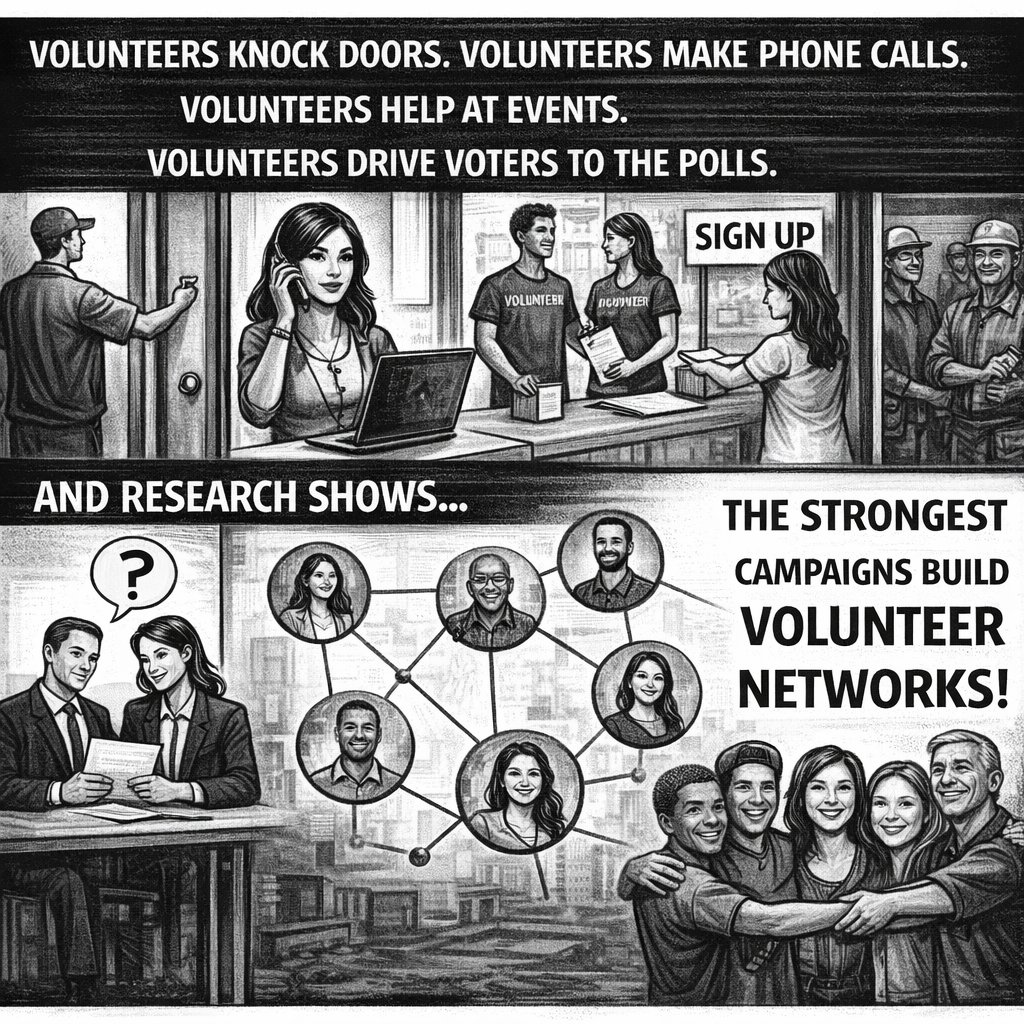
The Volunteer Network Effect
The research found that volunteers who developed more social connections within the campaign completed more volunteer activities and contributed more volunteer hours. As volunteers became more connected to other volunteers, their participation increased.
The reason is simple. Campaigns provide more than political opportunities. They provide social opportunities.
Volunteers build friendships. They form working relationships. They become part of a team pursuing a common purpose. The campaign becomes a community. As social connections increase, so does commitment. This phenomenon mirrors findings from leadership and network science research, which show that behavior spreads through social networks. Individuals are influenced not only by leaders, but by the actions, expectations, and participation of people around them.
Participation becomes contagious. Commitment becomes contagious. Volunteerism becomes contagious.
Why Volunteer Recruitment Matters
Most local campaigns think about volunteers as a way to complete campaign tasks.
A more effective way to think about volunteers is that volunteers create campaign capacity. One volunteer may knock on 50 doors, attend a campaign event, and make 100 phone calls. But that same volunteer may also recruit a spouse, a neighbor, a coworker, and a friend. Suddenly one volunteer becomes five volunteers. Those five volunteers become twenty. The campaign grows through relationships rather than advertising. The research found that social recruitment was dramatically more effective than campaign recruitment. In one field experiment, volunteers recruited by friends participated at nearly ten times the rate of those recruited through traditional campaign outreach.
The implication is profound. The campaign's best recruiters are not campaign staff. The campaign's best recruiters are existing volunteers.
Volunteers Drive Every Major Campaign Activity
A successful campaign depends on volunteers for nearly every activity that directly influences election outcomes. Door canvassing: Research consistently identifies face-to-face voter contact as one of the most effective voter outreach methods. Volunteers make this possible. Community events: House parties, school events, neighborhood gatherings, and local forums all depend on volunteer participation. Volunteers invite attendees through their own social networks. Voter identification: Volunteers help campaigns identify supporters, undecided voters, and community concerns. The quality of voter data depends heavily on volunteer engagement. Get Out The Vote: As Election Day approaches, volunteers deliver reminders, make calls, send texts, knock doors, and provide rides to polling locations. Without volunteers, GOTV operations become dramatically smaller.
Managing Volunteers Means Managing Relationships
Many campaigns invest significant effort recruiting volunteers but relatively little effort managing them. The research suggests that volunteer management should focus on strengthening relationships among volunteers. The goal is not merely to assign tasks. The goal is to increase network connections. Every new connection increases the likelihood that volunteers remain active and engaged. Campaigns should:
- Introduce volunteers to one another.
- Encourage team-based canvassing.
- Hold social gatherings.
- Create neighborhood leadership roles.
- Recognize volunteer contributions publicly.
- Encourage volunteers to recruit friends and family.
The Candidate's Role
Candidates often spend enormous amounts of time communicating with voters. The research suggests they should spend time communicating with volunteers as well. Volunteers are not simply campaign workers. They are campaign multipliers. Candidates who invest in volunteer relationships create stronger volunteer networks. Stronger volunteer networks create stronger voter outreach. Stronger voter outreach creates stronger turnout.
Every volunteer brings:
- Additional relationships.
- Additional credibility.
- Additional trust.
- Additional reach.
The Strategic Takeaway
The most important lesson from social network research is that campaigns grow through relationships.
The strongest campaigns do not recruit volunteers one at a time. They recruit networks.
A campaign that learns how to activate friendships, families, neighborhoods, workplaces, and community organizations creates a self-reinforcing cycle: volunteer -> recruits friend -> friend recruits another friend -> volunteer network expands -> more canvassing -> more events -> more voter contacts -> stronger GOTV.
Campaigns often focus on persuading voters. Great campaigns focus on connecting people.
Because in politics, just as in communities, relationships are the infrastructure that make everything else possible.
How Winning Campaigns Apply This
Winning campaigns introduce volunteers to one another, organize team-based work, create visible leadership roles, and deliberately encourage existing volunteers to recruit from their own networks.
How brb Campaigns streamlines your work
We help teams track volunteer readiness, organize their assignments, and keep volunteer and voter follow-up visible. We build volunteers who turn into a broader network of campaign support.
Key Takeaways
- Volunteers recruited through trusted personal relationships are more likely to join and stay active than volunteers recruited directly by campaign staff.
- As volunteers form more connections inside the campaign, they contribute more hours and participate in more campaign activities.
- Volunteer management is strongest when campaigns build community, shared identity, and peer-to-peer recruitment rather than focusing only on task assignment.