GOTV is a System
The strongest campaigns begin building their GOTV operation months before voters ever cast a ballot. GOTV is not a single activity. It is a coordinated system that combines voter identification, relationship building, volunteer recruitment, direct voter contact, and Election Day execution.
Most importantly, successful GOTV efforts are built around people, not messages. Political science research consistently shows that personal contact remains one of the most effective methods for increasing voter turnout. Door-to-door canvassing produces significantly larger turnout effects than most other forms of campaign communication because personal interaction creates accountability, trust, and social connection.
The question for a candidate is not whether GOTV works. The question is how to organize every campaign activity around a single objective: getting identified supporters to actually vote.
Building the Foundation: Voter Identification
Before a campaign can mobilize voters, it must identify them.
Every voter contact should answer three questions:
- Do they support the candidate?
- How likely are they to vote?
- Are they willing to volunteer?
This information becomes the foundation of the GOTV plan. Research suggests campaigns are most effective when they focus on supporters whose voting decision is not yet certain. Rather than repeatedly contacting voters who will vote regardless, campaigns should invest resources in voters who support the candidate but have not yet fully committed to participating.
This is why voter identification must occur early. The campaign is not simply counting supporters. It is identifying who still needs motivation.
House Parties Create the Volunteer Network
A GOTV operation succeeds or fails based on volunteers. The strongest volunteer recruitment tool available to local campaigns is often the neighborhood house party. A committed supporter hosts neighbors in their home and introduces them to the candidate. These events create trust because the invitation comes from someone the attendees already know.
House parties accomplish several goals simultaneously:
- Recruit volunteers.
- Identify supporters.
- Build neighborhood relationships.
- Generate future event hosts.
- Create future canvassers.
Most importantly, house parties transform individual supporters into community leaders. A campaign that develops neighborhood leaders develops a scalable GOTV operation.
Door Canvassing Is the Primary Mobilization Tool
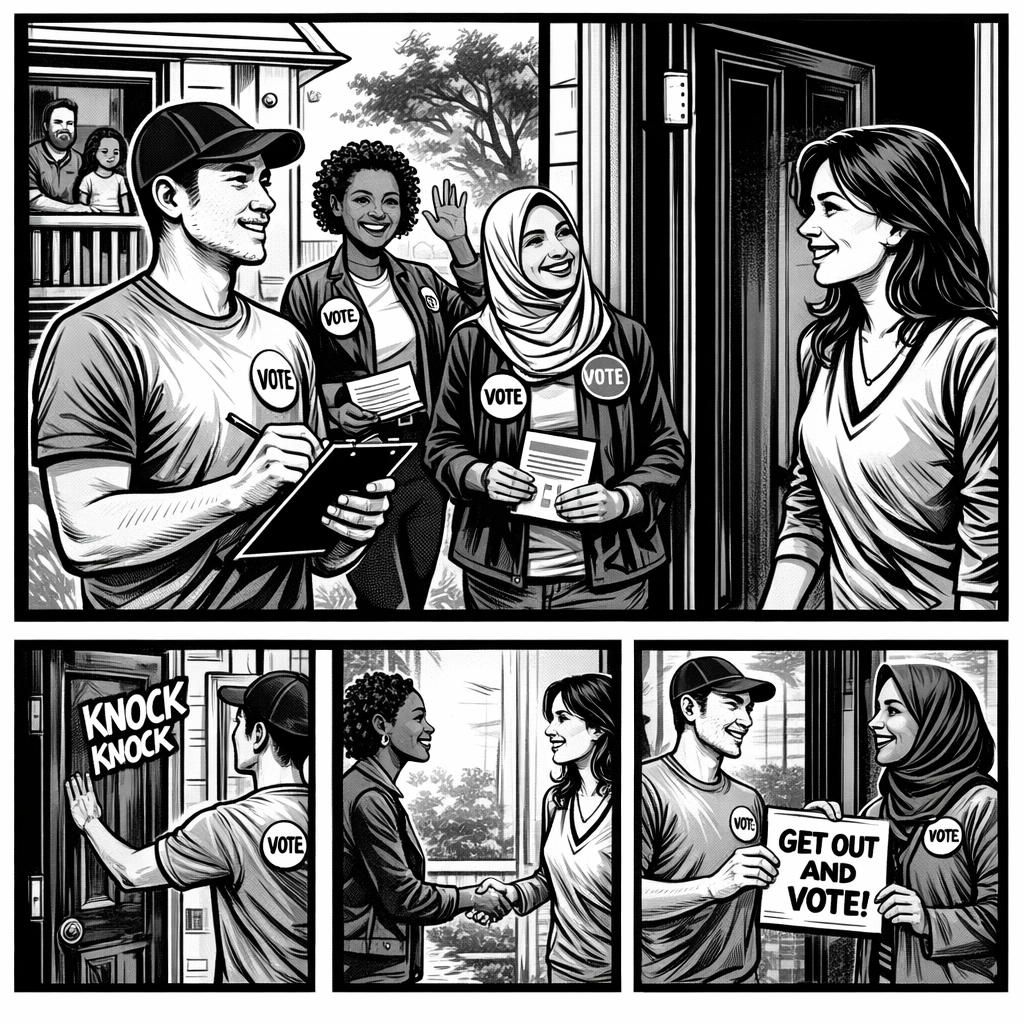
Once supporters have been identified, door canvassing becomes the campaign's most important voter contact method. The Gerber and Green field experiment found that face-to-face contact significantly increased voter turnout and consistently outperformed more impersonal forms of outreach. Personal contact increased turnout by approximately 8-10 percentage points in their analysis.
Door canvassing works because it creates human connection. The voter is not receiving information. The voter is participating in a conversation.
Good canvassing accomplishes three goals:
- Reinforces support.
- Strengthens commitment.
- Identifies barriers to voting.
A voter who has spoken with a candidate or volunteer multiple times becomes far more likely to follow through on Election Day.
Telephone Canvassing Supports the Field Program
The research found substantially weaker effects from telephone outreach than from face-to-face conversations. In some experiments, telephone contact produced little measurable turnout increase. This does not mean phone banking has no role. Instead, campaigns should view phone outreach as a support system for field operations.
Phone calls can:
- Confirm voter information.
- Schedule volunteer shifts.
- Remind supporters about events.
- Reinforce previous conversations.
- Follow up after canvassing.
The phone should extend relationships already created through personal contact. It should not replace them.
Direct Mail Reinforces Commitment
The research found that direct mail can increase turnout, although generally less effectively than face-to-face contact. Multiple mail pieces produced measurable but smaller gains than door canvassing. Direct mail is most effective when it reinforces relationships already established through other campaign activities.
For example: House Party -> Door Knock -> Mail Piece -> Follow-Up Call.
Each contact reminds the voter that participation matters. The mail piece becomes part of a larger conversation rather than a standalone communication.
Prioritize the Right Voters
One of the most important findings from modern GOTV research is that not every voter should receive the same level of attention. Arceneaux and Nickerson found that voter mobilization works best among people whose participation decision is near the threshold between voting and staying home. The specific voters who fall into that category depend on the election environment.
For practical campaign purposes:
- Level 1: Strong supporters who will definitely vote.
- Level 2: Supporters who will probably vote.
- Level 3: Supporters who like the candidate but remain uncertain.
The greatest opportunity often exists among Level 3 supporters. The campaign's objective is to move: Level 3 -> Level 2 -> Level 1 before Election Day arrives.
Election Month: Integrating Every GOTV Tool
The most effective GOTV plans integrate every campaign activity into a single coordinated system: House Parties -> Recruit Volunteers -> Door Canvassing -> Voter Identification -> Direct Mail Reinforcement -> Phone Follow-Up -> Voting Commitment -> Election Day Turnout.
Each activity supports the next. No contact occurs in isolation. The campaign continuously strengthens relationships while moving supporters closer to a voting commitment.
The Strategic Takeaway
The most successful campaigns do not treat GOTV as an Election Day activity. They treat GOTV as the culmination of every relationship built throughout the campaign. House parties recruit volunteers. Volunteers conduct canvassing. Canvassing identifies supporters. Direct mail reinforces the message. Phone calls maintain contact. Election Day converts commitment into participation.
Research consistently shows that personal contact remains the strongest driver of turnout. The campaigns that build the largest networks of trusted human relationships are often the campaigns that outperform expectations on Election Day. The best GOTV plans are not communication plans. They are relationship-building plans.
How Winning Campaigns Apply This
Winning campaigns identify supporters early, recruit neighborhood leaders through house parties, use canvassing as the primary turnout lever, and let phone and mail reinforce relationships that were already built face to face.
How BRB Campaigns Supports This
brb Campaigns helps teams keep supporter identification, volunteer recruitment, door programs, follow-up calls, and turnout execution aligned so GOTV operates as one connected system instead of a collection of disconnected tasks.
Related BRB workflow: Supporter identification, volunteer recruitment, canvassing, follow-up, and turnout execution
Key Takeaways
- GOTV works best when campaigns treat it as a full operating system rather than a final-week tactic.
- Face-to-face canvassing remains the strongest mobilization tool because it creates accountability, trust, and social connection that other channels rarely match.
- Campaigns should focus disproportionate attention on supportive voters whose participation is still uncertain rather than overinvesting in people who will vote regardless.