Build a Winning GOTV Plan
Start earlier than you think. The strongest campaigns begin planning their GOTV operation four to six months before voters cast a ballot. Successful turnout operations are built through voter identification, volunteer recruitment, relationship building, and repeated personal contact. Election Day is simply the final stage of a much longer process.
The goal of every GOTV plan is simple: move supporters from agreement to action. A supporter who likes the candidate but stays home does not help the campaign. A supporter who develops a voting plan and casts a ballot does.
Phase 1: Build the Volunteer Network
Timeline: 120-180 days before Election Day.
Objectives:
- Recruit volunteers
- Identify neighborhood leaders
- Hold house parties
- Build campaign infrastructure
A campaign's ability to turn out voters depends on the size and quality of its volunteer network. House parties are particularly effective because they recruit volunteers, identify supporters, develop neighborhood relationships, and create future event hosts and canvassers. Every successful GOTV operation begins by building a team capable of reaching voters personally.
Deliverables: Volunteer recruitment plan, neighborhood captain list, house party calendar, and volunteer training program.
Phase 2: Conduct Voter Identification
Timeline: 90-120 days before Election Day.
Objectives:
- Identify supporters
- Identify undecided voters
- Learn voter concerns
- Build voter database
Every voter contact should answer three questions: do they support the candidate, how likely are they to vote, and are they willing to volunteer? Use a voter identification scale: 1 strong supporter who will definitely vote, 2 supporter who will probably vote, 3 supporter who likes the candidate but remains uncertain, 4 opposed, 5 strongly opposed, 6 strongly opposed and will vote. The campaign's greatest opportunity usually lies with Level 3 voters because they still have room to move toward commitment.
Deliverables: Supporter universe, volunteer universe, issue identification database, and initial turnout targets.
Phase 3: Move Voters From 3 to 2
Timeline: 60-90 days before Election Day.
Objectives: increase voter engagement, build relationships, strengthen candidate recognition, and demonstrate relevance.
Tactics:
- Door canvassing
- Community events
- House parties
- Candidate meet-and-greets
- Follow-up calls
A voter at Level 3 likes the candidate but is uncertain about voting. Campaign conversations should focus on why the election matters, community impact, personal relevance, and local consequences. The objective is not persuasion. The objective is engagement. The campaign should help voters begin seeing themselves as part of the solution.
Phase 4: Move Voters From 2 to 1
Timeline: 30-60 days before Election Day.
Objectives: build commitment, create voting plans, and remove barriers.
Tactics:
- Follow-up canvassing
- Direct mail
- Voting guides
- Early voting education
- Personalized outreach
A Level 2 voter intends to vote but may still fail to participate. At this stage, campaigns should help voters answer practical questions: where do I vote, when do I vote, what identification is required, can I vote early, and how do I vote by mail?
The objective is to transform intention into commitment.
Phase 5: Execute the GOTV Program
Timeline: 14-30 days before Election Day.
Objectives: confirm support, reinforce voting plans, and increase turnout likelihood.
Deliverables:
- Walk lists
- Phone lists
- Mail schedule
- Volunteer shifts
- Precinct coverage plan
Research consistently shows that personal contact remains the strongest turnout tool available to campaigns. Door-to-door canvassing should be the centerpiece of the GOTV operation. Direct mail and phone calls should reinforce previous personal contact rather than replace it.
Integrated GOTV sequence: House Party -> Volunteer Recruitment -> Door Canvassing -> Voter Identification -> Direct Mail -> Phone Follow-Up -> Voting Commitment -> Election Day Turnout.
Phase 6: Election Week and Election Day
Timeline: Final 7 days.
Objectives: ensure ballot completion, eliminate voting obstacles, and contact every identified supporter.
Tactics:
- Final door knocks
- Reminder calls
- Text messages
- Polling place assistance
- Ride-to-poll programs
Focus on Level 1 and 2 supporters, with high priority for Level 3 supporters. Election Day communication should be simple: reminder, polling location, voting hours, and transportation assistance if needed. At this point, persuasion is over. Execution begins.
The Research-Based GOTV Formula
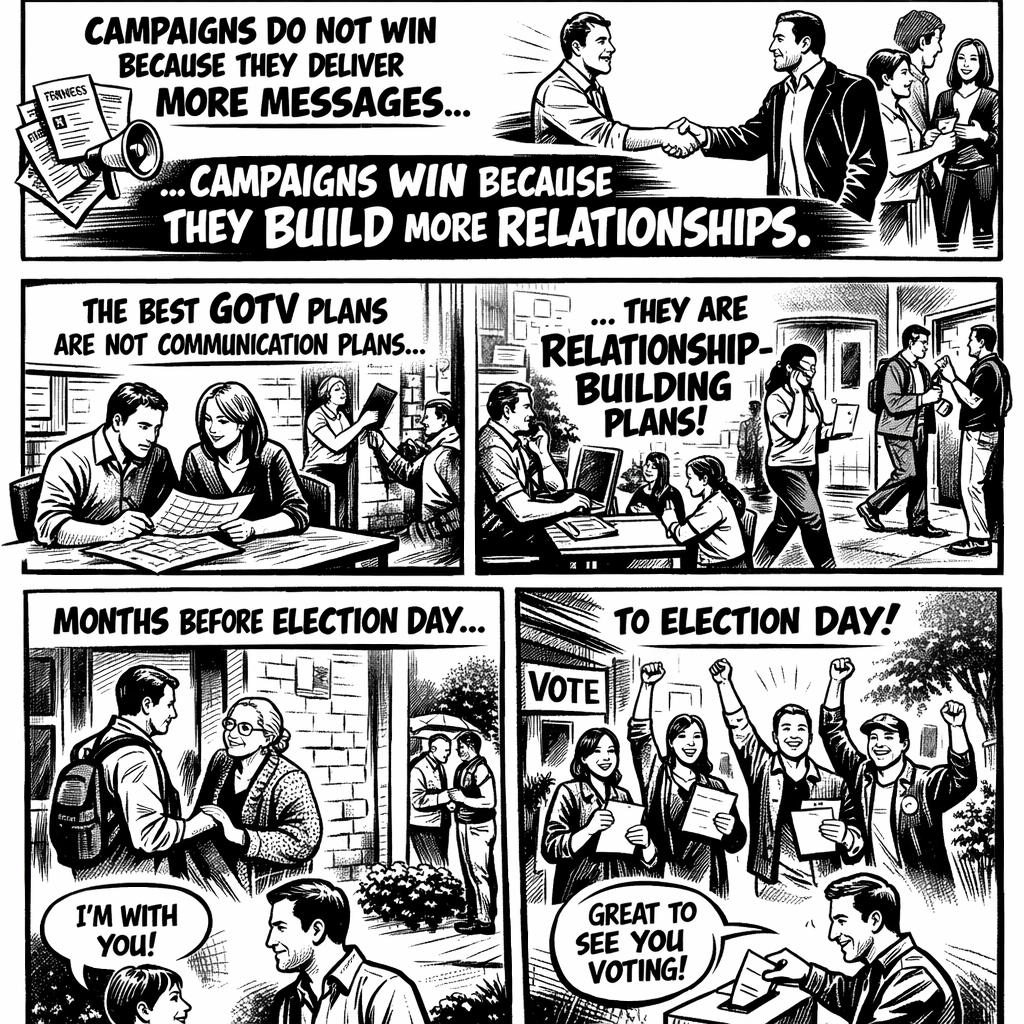
The strongest campaigns follow a simple progression: build volunteers, identify supporters, move 3s to 2s, move 2s to 1s, create voting plans, execute GOTV, turn out voters. The most important lesson from political science research is that campaigns do not win because they deliver more messages. Campaigns win because they build more relationships. The best GOTV plans are not communication plans. They are relationship-building plans that begin months before Election Day and culminate in voters successfully completing the journey from support to participation.
How Winning Campaigns Apply This
Winning campaigns build volunteer infrastructure first, identify supporters early, segment voters by readiness, and use repeated personal contact to move uncertain supporters toward concrete voting plans before the final GOTV push begins.
How BRB Campaigns Supports This
brb Campaigns helps teams organize volunteer recruitment, supporter identification, outreach sequencing, and final-week turnout execution so the campaign's GOTV plan stays coordinated from early planning through Election Day.
Related BRB workflow: Volunteer recruitment, voter identification, outreach sequencing, and GOTV execution
Key Takeaways
- GOTV planning should begin months before Election Day because volunteer capacity, voter identification, and relationship-building all shape turnout before the final week arrives.
- Door canvassing remains the centerpiece of a strong turnout operation, while phone calls and mail work best as reinforcement rather than replacements for personal contact.
- Volunteer networks and neighborhood relationships increase campaign reach because trusted people influence supporters more effectively than impersonal reminders alone.