The Winning Canvassing Plan
All politics is local, and all local politics is personal. Local elections are won through relationships.
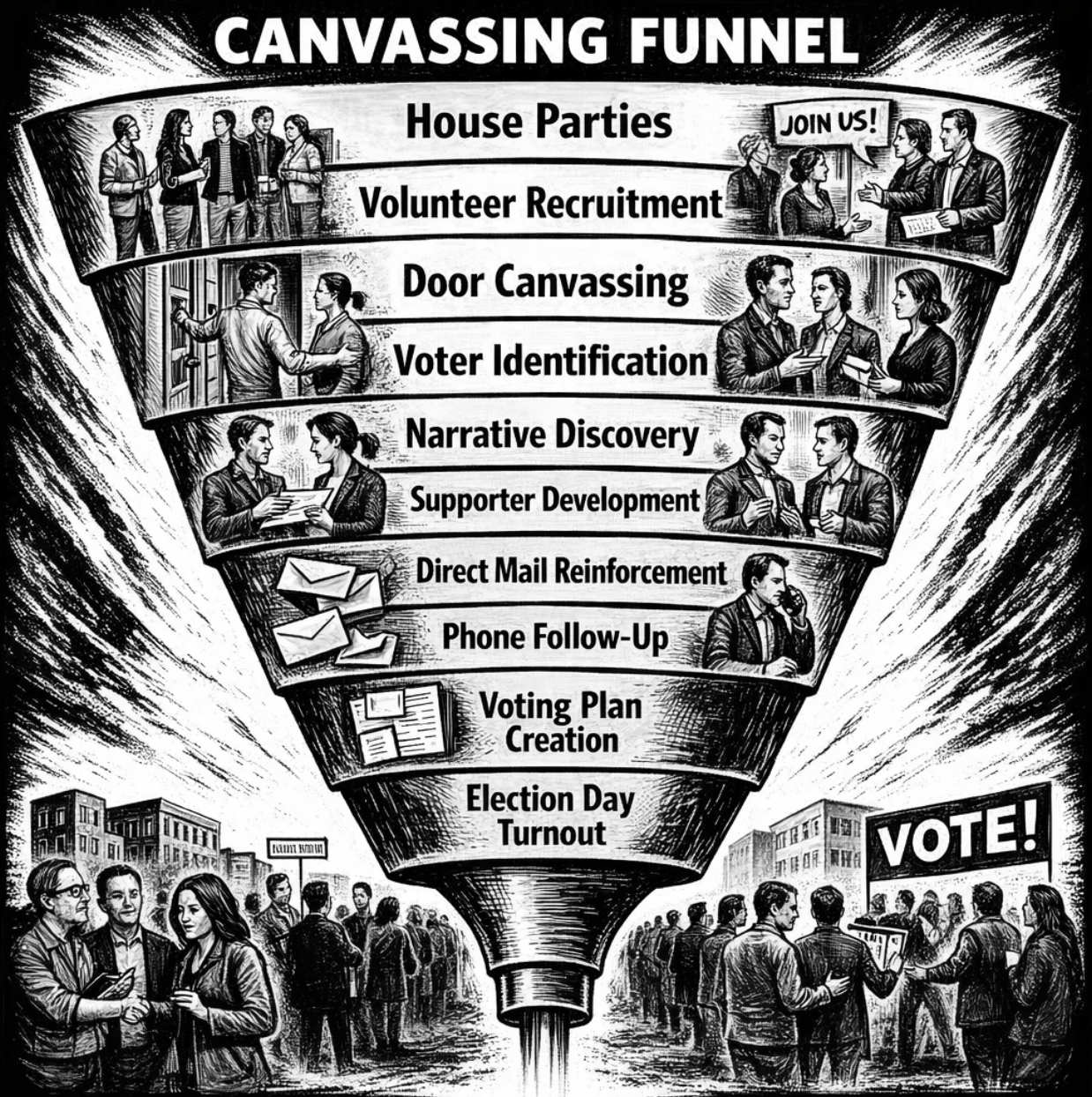
Door canvassing remains one of the most effective voter contact methods ever studied because it combines trust, human connection, voter identification, volunteer recruitment, and turnout mobilization into a single activity.
More importantly, canvassing allows campaigns to create and distribute a competing narrative that can overcome financial disadvantages. A television advertisement tells voters what to think. A conversation allows voters to decide for themselves. When a trusted neighbor, volunteer, or candidate shares a story at the front door, that message enters the voter's social network. Research consistently shows that social relationships and personal interaction are among the strongest drivers of participation and persuasion.
The strongest local campaigns create community conversations.
Phase 1: Build the Foundation (6 Months Before Election Day)
Six months before Election Day is when the campaign begins building its infrastructure.
- Recruit volunteers
- Create neighborhood leadership teams
- Develop your campaign narrative
- Build the voter database
This means finding area leaders, building core voter support, creating canvassing materials, and training volunteers. At this stage, the goal is not persuasion. The goal is building the organization that will conduct the field program.
Deliverable: A volunteer team capable of sustained voter contact.
4-5 Months Before Election Day: Voter Identification
This is the voter ID phase, where the campaign identifies supporters, identifies persuadable voters, learns neighborhood concerns, and discovers local issues.
- Do you support the candidate?
- What concerns you most about the community?
- Would you like campaign updates?
- Would you volunteer?
Canvassing at this stage is primarily a listening exercise. The campaign is gathering information and discovering how voters already understand local issues.
Deliverable: Voter ID scale: 1 = Strong supporter, 2 = Leaning supporter, 3 = Supportive but uncertain voter, 4 = Opposed but uncertain voter, 5 = Opposed, 6 = Strongly opposed.
Phase 2: Narrative Development (3-4 Months Before Election Day)
This is when the campaign begins to analyze voter feedback, refine its message, and develop issue priorities. This is where most campaigns attempt to invent their campaign message, but strong campaigns discover it.
The strongest campaign narratives emerge from what voters repeatedly tell the campaign.
- Common frustrations
- Shared hopes
- Recurring themes
- Community priorities
At this point the campaign message becomes: What are voters already trying to tell us?
Deliverable: Issue-focused narrative grounded in voter conversations.
2-3 Months Before Election Day: Expand the Network
This is where the hard work of starting early begins to pay off. Visibility increases, the supporter network grows, and volunteers begin recruiting additional volunteers.
- Additional canvassing rounds
- House parties
- Community events
- Volunteer recruitment drives
Research suggests that social relationships amplify campaign effectiveness. A supporter who becomes a volunteer can influence family members, neighbors, coworkers, and friends. The campaign should focus on identifying supporters who can influence other voters.
Deliverable: Growing volunteer and supporter network.
Phase 3: Commitment Building (30-60 Days Before Election Day)
The campaign has built a movement. Now it guides supporters toward commitment, confirms their support, and begins creating voting plans. This is where 3s move to 2s and 2s move to 1s. Conversations shift from issues to action, and the questions become:
The campaign is helping supporters move from agreement to participation.
- Have you made a voting plan?
- Will you vote by mail?
- Do you know your polling location?
- Would you like reminders?
Deliverable: Committed voter universe.
Phase 4: GOTV (Final 30 Days)
In the final 30 days, the foundation is built and the movement has momentum. The campaign reinforces those relationships, talks to voters about their voting plans, and gets them to the polls. Every voter contact channel should work together so each contact reinforces previous conversations. The voter begins to feel: They know who I am. They listened. They followed up.
This creates trust, and trust increases turnout.
- Door knock
- Follow-up phone call
- Direct mail piece
- House party invitation
- Reminder contact
Final 7 Days: Execution Begins
The final week is about turning commitment into ballots and contacting every identified supporter. Focus on strong supporters, likely supporters, and high-value uncertain supporters.
- Door knocking
- Phone banking
- Text reminders
- Polling information
- Vote-by-mail follow-up
At this stage persuasion is over.
Execution begins.
The Strategic Takeaway
The best canvassing programs do not treat door knocking as a turnout tactic.
They treat it as a relationship-building system. Canvassing identifies supporters. Canvassing discovers issues. Canvassing shapes the campaign narrative. Canvassing recruits volunteers. Canvassing builds trust. Canvassing increases turnout.
Most importantly, canvassing allows local campaigns to compete against larger budgets by replacing expensive advertising with trusted human relationships. The campaigns that win local elections are often not the campaigns that spend the most money. They are the campaigns that create the most authentic conversations throughout the community.
The purpose of canvassing is not merely to persuade voters. The purpose of canvassing is to build and distribute a trusted community narrative through repeated human relationships. Supported by decades of field experiments, those relationships ultimately become turnout on Election Day.
How Winning Campaigns Apply This
Winning local campaigns start early, organize neighborhood leadership, learn from voter conversations, build supporter-to-volunteer pathways, and then use final-week outreach to activate commitments that were earned over months of repeated contact.
How brb Campaigns Supports This
brb Campaigns helps teams connect voter targeting, volunteer coordination, canvassing follow-up, and GOTV execution so the field plan moves from relationship-building to ballots without losing operational continuity.
Related BRB workflow: Voter targeting, volunteer coordination, canvassing follow-up, and GOTV execution
Key Takeaways
- Canvassing is strongest when campaigns use it as one integrated system for voter identification, volunteer recruitment, narrative discovery, and turnout follow-through.
- A six-month timeline matters because organization, supporter movement, and volunteer network effects are built long before the final GOTV window begins.
- Local campaigns can compete against larger budgets by creating trusted community conversations that reinforce commitment through repeated human contact.