Strategy Guide

Repeated voter contact works because people move through awareness, familiarity, trust, commitment, and action. Local campaigns can use that pattern to combine mail, canvassing, follow-up, and GOTV into one stronger outreach system.

Strategy GuideBy BRB Campaigns Editorial Team2026-06-07

Core principle

People rarely change behavior after a single interaction. They move through awareness, familiarity, trust, commitment, and action.

Why this matters

Mail, canvassing, phone follow-up, and GOTV work best when they reinforce each other instead of acting like disconnected outreach tactics.

Best use

Local campaigns should treat repeated touches as one coordinated voter-relationship sequence rather than a set of isolated campaign contacts.

The "Multiple Touches" Principle

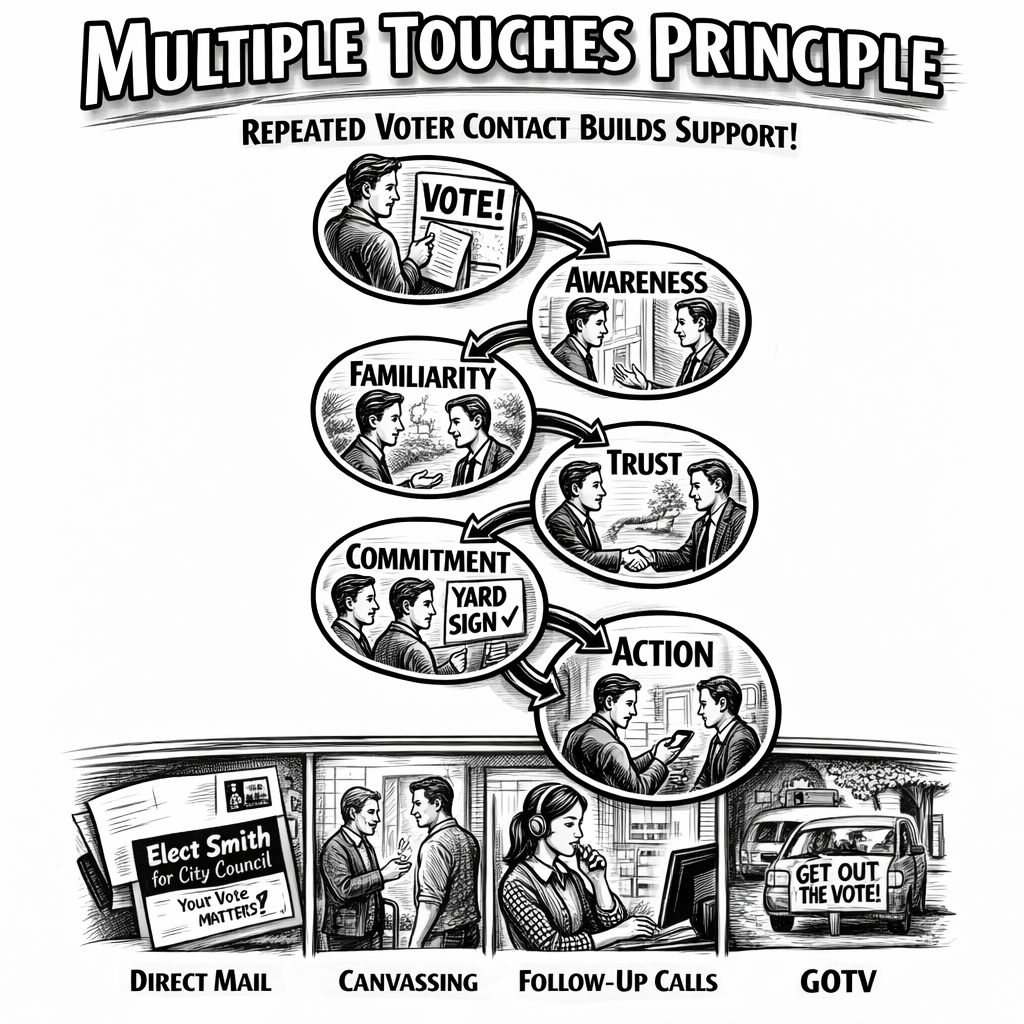
Several direct-mail experiments found that repeated mailings can continue to increase turnout, although the benefit eventually levels off after multiple contacts. This aligns with a broader finding from voter mobilization research: people rarely change behavior after a single interaction. Instead, they move through stages of awareness, familiarity, trust, commitment, and action.

Multiple touches sequence showing repeated voter contact across mail, canvassing, follow-up, and turnout reminders.

Why Repeated Contact Works

This is exactly why combining mail and canvassing is strategically attractive. The strongest sequences do not ask voters to jump from first contact to Election Day commitment in one step. They build recognition first, then trust, and only then ask for turnout behavior.

The Strongest Theoretical Combination

For local campaigns, especially school board and city council races, a strong sequence can begin with introduction mail to establish name recognition, introduce the candidate, and signal legitimacy before a canvasser arrives.

The second step is a door canvass focused on building rapport, listening, identifying issues, and recording support level. This is where the real persuasion and trust-building occur, and the evidence consistently shows that personal contact is the most powerful mobilization tool.

The third step is a follow-up phone call with an event reminder. This reinforces the conversation, demonstrates responsiveness, and reminds the voter that the campaign listened.

What Strong Follow-Up Looks Like

Instead of generic messaging such as "Vote for Sarah Smith," the follow-up can connect directly to what voters already discussed in conversation.

For example: "During our conversations in your neighborhood, we heard concerns about teacher retention and classroom resources. We have a house party down at your neighbor's house on this topic. You should come, we have free juice and snacks."

Now the follow-up validates the earlier relationship and leads the voter toward a group activity instead of treating outreach like a one-way broadcast.

Phase 4: GOTV Contact

The fourth step is GOTV contact. At that point, mail, texts, phone calls, and door knocks are all reinforcing a turnout commitment that was built through earlier touches. The final contact phase is about converting support into turnout. This is where all channels reinforce the voting plan:

  • Mail
  • Texts
  • Phone calls
  • Door knocks

How Winning Campaigns Apply This

Winning campaigns use repeated contact to move voters from recognition to trust to turnout. They introduce themselves early, learn at the doors, follow up in ways that prove they listened, and then use GOTV outreach to convert that relationship into a voting plan.

How BRB Campaigns Supports This

BRB Campaigns helps teams connect list-building, canvassing, follow-up, and GOTV execution so repeated touches feel like one coordinated strategy rather than scattered campaign activity.

Related BRB workflow: Strategic List Builder, canvassing follow-up, event reminders, and GOTV sequencing

Key Takeaways

  • Voters usually move through awareness, familiarity, trust, commitment, and action rather than responding to a single campaign touch.
  • Mail works best as an early recognition or reinforcement tool when it is paired with stronger forms of personal contact such as canvassing and follow-up calls.
  • The best GOTV operations are built on prior relationship touches, not just final-week reminders.

Continue by topic

Why Door Canvassing Still Wins Elections

Door canvassing is a leadership development exercise that teaches you how to listen, build trust, and shape your campaign message.

Research Review

Why Door Canvassing Matters

Door canvassing remains the gold standard of voter mobilization because face-to-face conversations build trust, reveal what voters actually care about, and help campaigns organize more effectively.

GOTV Guide

The Winning Canvassing Plan

A relationship-driven GOTV plan starts early, uses canvassing to organize the campaign, and turns repeated voter contact into turnout on Election Day.

GOTV Guide

Build a Winning GOTV Plan

The strongest GOTV plans start months before Election Day and use volunteer networks, voter identification, and repeated personal contact to move supporters from agreement to action.

Volunteer Management Guide

House Parties Win Neighborhoods

House parties are one of the strongest ways to turn neighborhood trust into volunteer growth, community ownership, and the personal relationships that drive turnout.

GOTV Guide

GOTV is a System

The strongest campaigns treat GOTV as an integrated system that starts months before Election Day and connects supporter identification, volunteer growth, personal contact, and turnout execution.

Read next

Continue with the related analysis most likely to help you deepen the same campaign decision.

Research Review

Why Door Canvassing Matters

Door canvassing remains the gold standard of voter mobilization because face-to-face conversations build trust, reveal what voters actually care about, and help campaigns organize more effectively.

Read Next

GOTV Guide

GOTV is a System

The strongest campaigns treat GOTV as an integrated system that starts months before Election Day and connects supporter identification, volunteer growth, personal contact, and turnout execution.

Read Next

Turn this into action

When you are ready to act on this analysis, these software pages show the BRB workflows most relevant to the work ahead.

Political Campaign Software

See the full campaign workspace that keeps planning, outreach, volunteers, and follow-up in one place.

Recommended workflowSee this in the brb Campaigns App

Door Canvassing Software

Turn voter targeting into door plans, packets, field shifts, and clearer follow-up after every conversation.

Recommended workflowExplore Door Canvassing

Voter Outreach Software

Organize voter targeting, outreach, and follow-up so your team stays focused on the voters who matter most.

Recommended workflowExplore Voter Outreach

GOTV Software

Build a calmer turnout plan for final-week outreach, volunteer assignments, and Election Day execution.

Recommended workflowExplore GOTV

Campaign Volunteer Management

Organize volunteer roles, staffing visibility, and follow-up so supporter energy turns into useful campaign work.

Recommended workflowExplore Volunteer Management

School Board Campaign Software

See practical workflows for school board candidates who need local outreach, volunteer support, and turnout planning.

Recommended workflowExplore School Board Workflows